


Dragon Sword
Part 2: September 5, 9-12
(Click for audio.)
The sword has long occupied a unique place within the Daoist tradition—not merely as a weapon, but as an instrument of refinement, exorcism, and alchemical transformation. In these two workshops, participants will be introduced to foundational principles and movements of Dragon Sword 龍化劍.
Balancing coiling softness with expansive flourishes, Dragon Sword emphasizes spiraling body mechanics, fluid footwork, and the cultivation of internal connection through the blade. The practice explores the sword not as an object separate from the body, but as an extension of awareness itself.
History
Dragon Sword belongs to the Mystical Transformation 玄真 tier of practices from the Northern Longfist system 北長拳. Hailing from Laoshan 嶗山 in Shandong 山東 province, mythohistories hold that Dragon Sword was created by Dragon Gate Lineage 龍門派 founder, Qiu Chuji 丘處機 (1148-1227) during his cultivation at the Cave of Bright Mist 明霞洞 in Laoshan, after being greatly influenced by the Zhuangzi 莊子 chapter called “Discussing Swordsmanship” (Shuojian 說劍). The practice was later passed down to Sun Xuanqing 孙玄清 (1497-1569), patriarch of the Golden Mountain Lineage 金山派 who received transmission from Zhang Sanfeng 張三丰 at the Cave of Bright Mist. Several sources document Zhang and Sun’s meeting, including Ren Yingzhi’s 任穎芝 Laoshan Daojiao Shi 嶗山道教史 (Laoshan Daoist History) and Sun Zhenren Ziyang Shu 孫真人紫陽疏 (Memorial of the Perfected Sun Ziyang), which Sun hand-carved into the rockface outside the cave still legible today.
Since this encounter, Zhang’s teachings have held considerable influence on Mount Lao. As a result, the place earned the nickname “Northern Wudang” 北武當, highlighting the relationship between the two mountains and their martial heritage. Fourteenth-generation disciple Zhong Yunlong 鍾雲龍 (1964) learned Dragon Sword in the 1980s during his tenure at Laoshan training under Golden Mountain Lineage disciple Kuang Changxiu (1904-1993). The enduring connection of Laoshan as Northern Wudang is reflected in a popular phrase from the time: “Guo in the south, Kuang in the north” (南郭北匡) honoring the two most famous Daoist martial artists of the time, Zhong’s masters Guo Gaoyi 郭高一 (1900-1993) of Wudang and Kuang Changxiu of Laoshan.
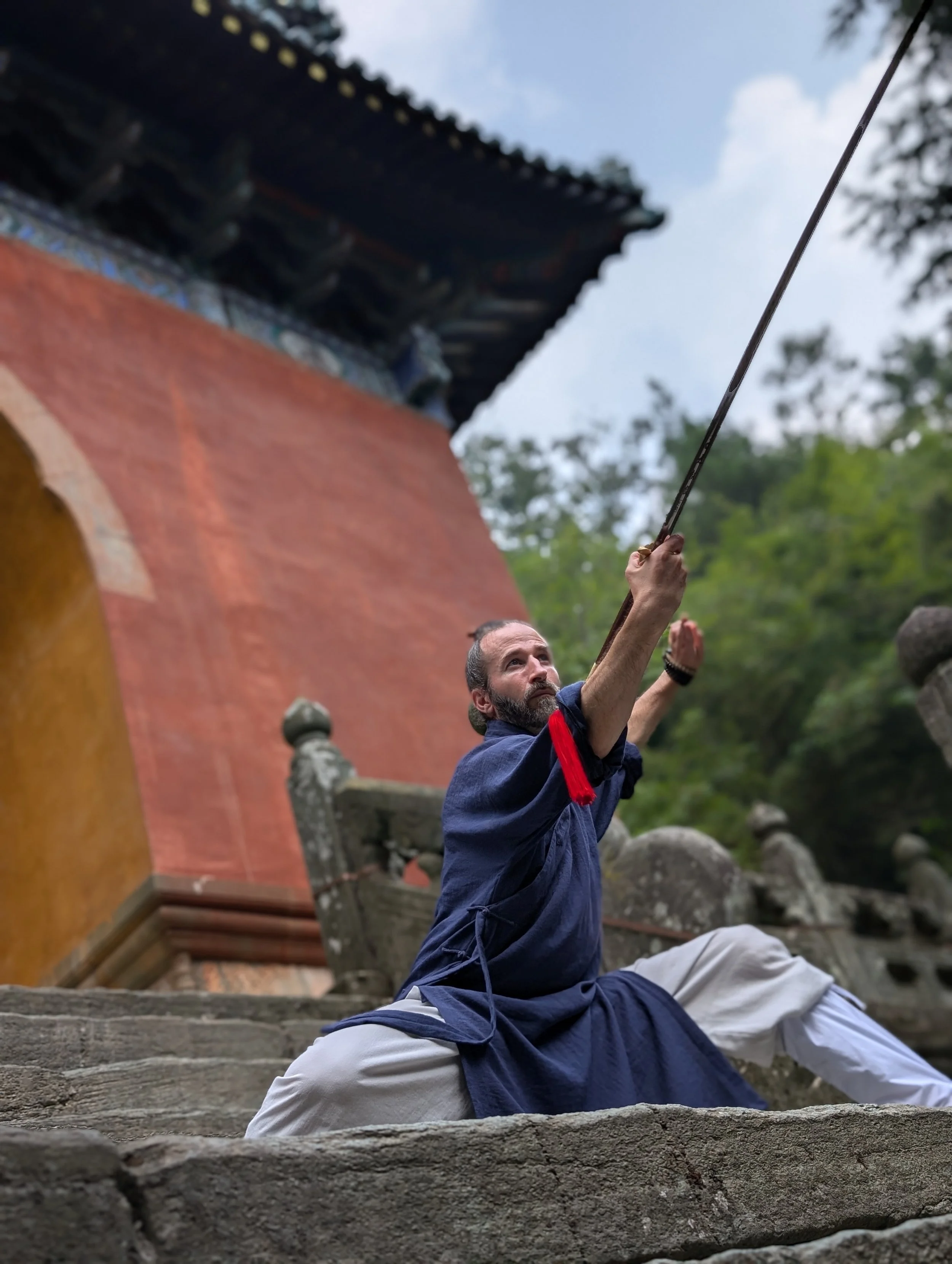
Workshop Format
Through a series of dynamic drills, the first workshop will explore the foundational basic techniques found throughout the Dragon Sword form, including:
Horizontal Chopping (zhanjian 斬劍)
Vertical Chopping (pijian 劈劍)
Clouding (yunjian 雲劍)
Twisting (jiaojian 絞劍)
Lifting (liaojian 撩劍)
Threading (chuanjian 穿劍)
Pecking (dianjian 點劍)
Stabbing (cijian 刺劍)
Wrist Cutting (jianwan 劍腕)
If you can get your hands on a copy of the book Sword Imperatives: Mastering the Kung Fu and Tai Chi Sword by Wang Jurong 王菊容 and Wu Wenqing 吳文慶 (my first teacher), you’ll find all of these techniques within, along with illustrations made by yours truly for the book over twenty years ago. Once a foundation and fluency in these basic techniques has been established, students will then begin learning the opening movements of the Dragon Sword form. The second workshop, held in August, will then complete the form.
Details
Workshop 2 will be held on Saturday, September 5 from 9:00 AM to 12:00 PM.
This workshop is open only to participants who attended Workshop 1, as we'll be building on the material covered there.
Cost
$149